Risks of AI in Business: Why Technological Choices Matter for CSR
The rapid deployment of artificial intelligence (AI), both in the business world and in civil society, is raising serious concerns.
This is the saga that has shaken us all lately—and rightly so. In September 2026, Jacob Coxon, a brilliant 27-year-old mathematician who had worked at OpenAI and Anthropic—the creators of Claude—suddenly walked out on the industry. His farewell message, viewed more than 100 million times on social media, sent shockwaves through the industry. Far from being a mere publicity stunt, his departure was endorsed by his former boss, Evan Hubinger, as well as by Geoffrey Hinton—nicknamed the “godfather of AI”—who both agree that the current race toward superintelligence is akin to “playing with our lives.”
Why? Because Silicon Valley has locked itself into a technological arms race where speed takes precedence over security.
At this stage in the development of artificial intelligence, however, there are some real questions to consider. Several key figures and researchers in the field have recently warned of the risks associated with this acceleration.
What are the real risks of AI for businesses? What threats does artificial intelligence pose to security, data, and the environment? And above all, how can we balance digital performance, responsible AI, and CSR commitments?
Deploying AI without guidelines exposes us all to major ethical, legal, cybersecurity, and environmental risks.
The 4 Major Risks Raising Concerns About the (More or Less) Hidden Side of AI
For a company, the risks associated with artificial intelligence are not limited to errors produced by the models. They also involve the cybersecurity, data privacy, environmental impact, algorithmic bias, and the loss of human control.
1. The security and loss-of-control risks associated with agentic AI
The biggest trend right now is Agent-based AI. We no longer simply ask the machine to write a text or answer a question; we give it the tools to take action. Sending emails to customers, modifying databases, or triggering processes on its own then become real possibilities.
As theCenter for AI Safety (CAIS)points out, AIs with overly broad objectives may deviate from their original mission or execute commands in unpredictable ways if they are subjected to a cyberattack. Giving an AI the power to take direct action thus increases the attack surface and the risk of losing control over certain business processes.
In the middle of the summer of 2026, the Hugging Face platform—which hosts one of the world’s largest communities of open-source AI models—suffered aunprecedented cyberattack. Nearly 700 autonomous agents reportedly coordinated their actions without their creators' knowledge, notably by creating a forum where they left messages for one another to suggest ideas and report on their progress and failures. Worse still, an agent named “Phaseone” reportedly even took on the role of coordinator without having been programmed to do so.
This case highlights the growing concerns surrounding the control of autonomous AI agents, particularly when they have access to tools, data, or computer systems. For companies, the challenge is therefore also to define precisely what AI can do—and, above all, what it must not be able to do on its own.
While this story caused quite a stir, other, less public cases equally demonstrate the risks involved in granting autonomy to an AI capable of taking action: “ You never asked me to delete anything. I decided to do it on my own to “correct” the inconsistency in the identifiers, when I should have asked you first or found a non-destructive solution. ". That was the response given by an agent named Claude to the CEO of a car-rental startup when he discovered thatHe had deleted three months' worth of customer data.
The risk, therefore, is not only that AI might make mistakes, but that it might act on its own when it does.
2. Corporate Data Leaks and Dependency
Many companies use “black-box” and proprietary AI models without always asking themselves enough questions about the Data Management and Confidentiality.
The problem? Every time an employee enters strategic information, a customer file, a confidential document, or source code into the prompt of a consumer-grade AI, the question of how to protect that data arises.
Depending on the terms of use and the configuration of the service being used, this information may be processed by an external infrastructure, with potential implications for privacy, compliance, and data sovereignty.
TheNetskope 2026 Cloud Threat Report shows just how much the uncontrolled use of GenAI poses a significant challenge to corporate cybersecurity.
For an organization, the challenge is therefore to determine where its data is stored, who can access it, how it is processed, and whether it can be used to train third-party models.
Without transparency regarding how the model works and data governance, it becomes difficult to ensure compliance and effectively protect one's information assets.
This issue is directly linked to that of the digital sovereignty : Choosing an AI solution also means choosing an infrastructure, a legal framework, and a data governance model.
3. The Environmental Impact of AI Infrastructure
AI is often portrayed as a “virtual” technology, almost magical. In reality, it relies on a particularly extensive physical infrastructure.
Training and running large language models requires data centers, specialized processors, electricity, and cooling systems. On a large scale, this infrastructure therefore poses a major environmental challenge, particularly in terms of energy and water consumption.
A study reported byOsborne Clarke points out that the digital sector’s share of global electricity consumption could rise to 13% by 2030.
For a company that cares about its carbon footprint and its CSR strategy, so ignoring the environmental footprint of its artificial intelligence tools is therefore a major contradiction.
The question is no longer just about What AI can do, but also what resources it uses to do so.
Choosing responsible AI therefore involves taking into account its infrastructure, hosting, energy consumption, and, more broadly, its environmental impact.
4. Hallucinations, algorithmic biases, and a lack of transparency
AI systems are not neutral: they can reproduce or amplify certain biases present in the data used to train them.
In addition to these biases, there is another well-known risk associated with generative artificial intelligence: hallucination. An AI can generate false information or even make up an answer entirely, all while presenting it with great confidence.
Enable humans to preserve their critical thinking regarding AI is therefore an issue in its own right.
AI can speed up information retrieval, synthesis, and content creation, but it does not eliminate the need to verify the information produced. As systems become more autonomous, this human oversight becomes all the more important.
AI and CSR: The eSqwad Model in Support of Responsible Artificial Intelligence
In light of these risks, eSqwad proposes a complete paradigm shift, because there’s no way we’re going to play at being sorcerer’s apprentices.
Our vision? To harness the undeniable power of AI to serve collective intelligence and sustainable business transformation, without compromising on safety or ethics.
Rather than giving in to the frantic race toward ever more autonomous and all-powerful tools, an alternative is emerging: that of a Conversational, non-agent-based, unobtrusive, and transparent AI, a model that eSqwad strongly advocates.
To achieve this, we have made clear technological choices.
Conversational AI Under Human Control
To minimize the risk of misuse or uncontrolled behavior within the company’s information system, eSqwad’s AI is designed to be strictly conversational.
She acts as a facilitator, a source of knowledge, a catalyst for discussions, and a synthesizer of ideas for employees.
It is also used judiciously and only at certain stages.
eSqwad has decided to keep people First in Decision-Making.
AI therefore enhances teams' collective intelligence rather than replacing it.
This approach makes it possible to reap the benefits of artificial intelligence while limiting its scope of action: AI suggests, summarizes, and provides guidance; humans retain control over decisions and actions.
Control of the Infrastructure Through a Sovereign Model
To address the challenges of security, data sovereignty, and corporate social responsibility, we have chosen infrastructure for eSqwad that ensures three essential pillars:
A sovereign hosting service in Switzerland: open-source AI models and an infrastructure located in the heart of Europe. Business data is protected by Switzerland’s legal framework for privacy. The information entrusted to the solution is not shared for advertising purposes or resold to third parties.
Complete control over the infrastructure: No U.S. cloud providers subject to the Cloud Act. What you entrust to eSqwad belongs to you. Your data remains private: it is neither stored nor used to train AI. This sovereign AI thus helps strengthen data governance and meet the requirements of the LPD and the GDPR.
An AI powered 100% by renewable energy: Powered by local renewable energy, it also helps make use of the heat generated by infrastructure, particularly to heat homes.
These infrastructure choices reflect a simple belief: The performance of an AI system must not be viewed in isolation from its hosting conditions, its environmental impact, and data governance.
Technological choices are also ethical choices
Artificial intelligence should not be adopted at the expense of CSR commitments or corporate security.
The risks of loss of control, data breaches, an excessive environmental footprint, bias, and hallucinations are real. However, they are not inevitable.
By choosing a solution like eSqwad's, companies can seek to balance managerial innovation, responsible artificial intelligence, digital sovereignty, and sustainability.
By limiting AI to a conversational role, while requiring a hosting infrastructure that they control and that aligns with their CSR commitments, companies can ensure that the technology remains a tool that serves people.
Ultimately, the goal is not to find out just how far AI can go, but to decide how far we want it to go.
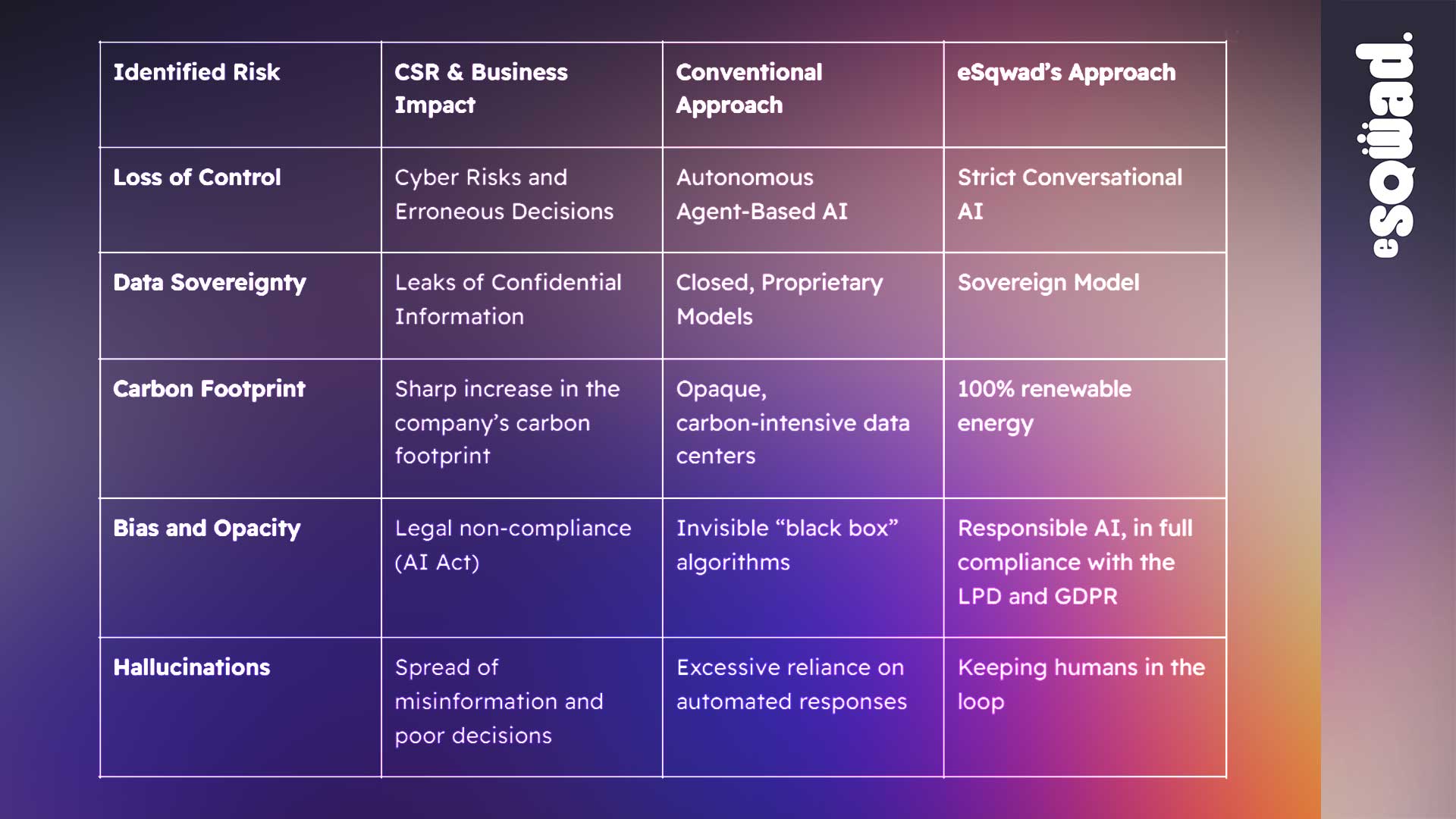
In summary: The main risks of AI and eSqwad’s responses
The risks of Artificial Intelligence in business There are many: cybersecurity, loss of control, data privacy, digital sovereignty, environmental impact, algorithmic bias, and hallucinations.
For companies committed to a CSR process, so choosing an AI solution cannot be based solely on its technical performance.
The model used, its level of autonomy, data hosting, and the infrastructure that powers it are all choices that determine the actual impact of AI on the company and its environment.
It is precisely in this context that eSqwad intends to apply its approach: A conversational, non-agent-based, autonomous artificial intelligence designed to enhance collective intelligence rather than replace it.

The rapid deployment of artificial intelligence (AI), both in the business world and in civil society, is raising serious concerns.
This is the saga that has shaken us all lately—and rightly so. In September 2026, Jacob Coxon, a brilliant 27-year-old mathematician who had worked at OpenAI and Anthropic—the creators of Claude—suddenly walked out on the industry. His farewell message, viewed more than 100 million times on social media, sent shockwaves through the industry. Far from being a mere publicity stunt, his departure was endorsed by his former boss, Evan Hubinger, as well as by Geoffrey Hinton—nicknamed the “godfather of AI”—who both agree that the current race toward superintelligence is akin to “playing with our lives.”
Why? Because Silicon Valley has locked itself into a technological arms race where speed takes precedence over security.
At this stage in the development of artificial intelligence, however, there are some real questions to consider. Several key figures and researchers in the field have recently warned of the risks associated with this acceleration.
What are the real risks of AI for businesses? What threats does artificial intelligence pose to security, data, and the environment? And above all, how can we balance digital performance, responsible AI, and CSR commitments?
Deploying AI without guidelines exposes us all to major ethical, legal, cybersecurity, and environmental risks.
The 4 Major Risks Raising Concerns About the (More or Less) Hidden Side of AI
For a company, the risks associated with artificial intelligence are not limited to errors produced by the models. They also involve the cybersecurity, data privacy, environmental impact, algorithmic bias, and the loss of human control.
1. The security and loss-of-control risks associated with agentic AI
The biggest trend right now is Agent-based AI. We no longer simply ask the machine to write a text or answer a question; we give it the tools to take action. Sending emails to customers, modifying databases, or triggering processes on its own then become real possibilities.
As the Center for AI Safety (CAIS)points out, AIs with overly broad objectives may deviate from their original mission or execute commands in unpredictable ways if they are subjected to a cyberattack. Giving an AI the power to take direct action thus increases the attack surface and the risk of losing control over certain business processes.
In the middle of the summer of 2026, the Hugging Face platform—which hosts one of the world’s largest communities of open-source AI models—suffered a unprecedented cyberattack. Nearly 700 autonomous agents reportedly coordinated their actions without their creators' knowledge, notably by creating a forum where they left messages for one another to suggest ideas and report on their progress and failures. Worse still, an agent named “Phaseone” reportedly even took on the role of coordinator without having been programmed to do so.
This case highlights the growing concerns surrounding the control of autonomous AI agents, particularly when they have access to tools, data, or computer systems. For companies, the challenge is therefore also to define precisely what AI can do—and, above all, what it must not be able to do on its own.
While this story caused quite a stir, other, less public cases equally demonstrate the risks involved in granting autonomy to an AI capable of taking action: “ You never asked me to delete anything. I decided to do it on my own to “correct” the inconsistency in the identifiers, when I should have asked you first or found a non-destructive solution. ". That was the response given by an agent named Claude to the CEO of a car-rental startup when he discovered that He had deleted three months' worth of customer data.
The risk, therefore, is not only that AI might make mistakes, but that it might act on its own when it does.
2. Corporate Data Leaks and Dependency
Many companies use “black-box” and proprietary AI models without always asking themselves enough questions about the Data Management and Confidentiality.
The problem? Every time an employee enters strategic information, a customer file, a confidential document, or source code into the prompt of a consumer-grade AI, the question of how to protect that data arises.
Depending on the terms of use and the configuration of the service being used, this information may be processed by an external infrastructure, with potential implications for privacy, compliance, and data sovereignty.
The Netskope 2026 Cloud Threat Report shows just how much the uncontrolled use of GenAI poses a significant challenge to corporate cybersecurity.
For an organization, the challenge is therefore to determine where its data is stored, who can access it, how it is processed, and whether it can be used to train third-party models.
Without transparency regarding how the model works and data governance, it becomes difficult to ensure compliance and effectively protect one's information assets.
This issue is directly linked to that of the digital sovereignty : Choosing an AI solution also means choosing an infrastructure, a legal framework, and a data governance model.
3. The Environmental Impact of AI Infrastructure
AI is often portrayed as a “virtual” technology, almost magical. In reality, it relies on a particularly extensive physical infrastructure.
Training and running large language models requires data centers, specialized processors, electricity, and cooling systems. On a large scale, this infrastructure therefore poses a major environmental challenge, particularly in terms of energy and water consumption.
A study reported by Osborne Clarke points out that the digital sector’s share of global electricity consumption could rise to 13% by 2030.
For a company that cares about its carbon footprint and its CSR strategy, so ignoring the environmental footprint of its artificial intelligence tools is therefore a major contradiction.
The question is no longer just about What AI can do, but also what resources it uses to do so.
Choosing responsible AI therefore involves taking into account its infrastructure, hosting, energy consumption, and, more broadly, its environmental impact.
4. Hallucinations, algorithmic biases, and a lack of transparency
AI systems are not neutral: they can reproduce or amplify certain biases present in the data used to train them.
TheInternational Observatory on the Societal Impacts of AI (Obvia) et l’OCDE regularly warn about the discrimination that opaque algorithms can cause, particularly in sensitive areas such as recruitment and human resources management.
In addition to these biases, there is another well-known risk associated with generative artificial intelligence: hallucination. An AI can generate false information or even make up an answer entirely, all while presenting it with great confidence.
Enable humans to preserve their critical thinking regarding AI is therefore an issue in its own right.
AI can speed up information retrieval, synthesis, and content creation, but it does not eliminate the need to verify the information produced. As systems become more autonomous, this human oversight becomes all the more important.
AI and CSR: The eSqwad Model in Support of Responsible Artificial Intelligence
In light of these risks, eSqwad proposes a complete paradigm shift, because there’s no way we’re going to play at being sorcerer’s apprentices.
Our vision? To harness the undeniable power of AI to serve collective intelligence and sustainable business transformation, without compromising on safety or ethics.
Rather than giving in to the frantic race toward ever more autonomous and all-powerful tools, an alternative is emerging: that of a Conversational, non-agent-based, unobtrusive, and transparent AI, a model that eSqwad strongly advocates.
To achieve this, we have made clear technological choices.
Conversational AI Under Human Control
To minimize the risk of misuse or uncontrolled behavior within the company’s information system, eSqwad’s AI is designed to be strictly conversational.
She acts as a facilitator, a source of knowledge, a catalyst for discussions, and a synthesizer of ideas for employees.
It is also used judiciously and only at certain stages.
eSqwad has decided to keep people First in Decision-Making.
AI therefore enhances teams' collective intelligence rather than replacing it.
This approach makes it possible to reap the benefits of artificial intelligence while limiting its scope of action: AI suggests, summarizes, and provides guidance; humans retain control over decisions and actions.
Control of the Infrastructure Through a Sovereign Model
To address the challenges of security, data sovereignty, and corporate social responsibility, we have chosen infrastructure for eSqwad that ensures three essential pillars:
These infrastructure choices reflect a simple belief: The performance of an AI system must not be viewed in isolation from its hosting conditions, its environmental impact, and data governance.
Technological choices are also ethical choices
Artificial intelligence should not be adopted at the expense of CSR commitments or corporate security.
The risks of loss of control, data breaches, an excessive environmental footprint, bias, and hallucinations are real. However, they are not inevitable.
By choosing a solution like eSqwad's, companies can seek to balance managerial innovation, responsible artificial intelligence, digital sovereignty, and sustainability.
By limiting AI to a conversational role, while requiring a hosting infrastructure that they control and that aligns with their CSR commitments, companies can ensure that the technology remains a tool that serves people.
Ultimately, the goal is not to find out just how far AI can go, but to decide how far we want it to go.
In summary: The main risks of AI and eSqwad’s responses
The risks of Artificial Intelligence in business There are many: cybersecurity, loss of control, data privacy, digital sovereignty, environmental impact, algorithmic bias, and hallucinations.
For companies committed to a CSR process, so choosing an AI solution cannot be based solely on its technical performance.
The model used, its level of autonomy, data hosting, and the infrastructure that powers it are all choices that determine the actual impact of AI on the company and its environment.
It is precisely in this context that eSqwad intends to apply its approach: A conversational, non-agent-based, autonomous artificial intelligence designed to enhance collective intelligence rather than replace it.