
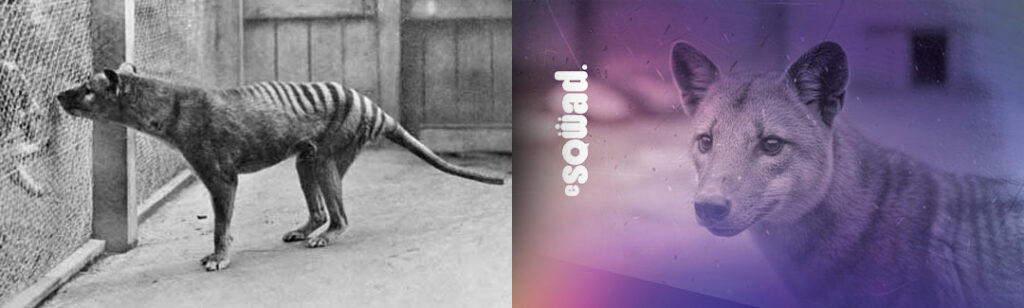
To give you a little background on the big story, Benjamin is now one of the many characters that participants in an eSqwad workshop can draw upon to explore the challenges of our time.
Most are fictional, most are human, he is neither.
However, we believe this is one of the most important characters we have introduced so far. capable of telling the story of the impact humans can have on other animals from his unique perspective as the last known member of a now extinct species.
Imagining and developing a personality for Benjamin, in order to bring him to life and pay tribute to him, was truly a challenge that we hope we have met.
Article published on March 13, 2026
We use cookies to improve your experience on our site. By using our site, you consent to cookies.
Manage your cookie preferences below:
Essential cookies enable basic functions and are necessary for the proper function of the website.
These cookies are needed for adding comments on this website.
Google reCAPTCHA helps protect websites from spam and abuse by verifying user interactions through challenges.
The thylacine, often nicknamed the "Tasmanian tiger", was not a canid, but a carnivorous marsupial. resembling a large sandy-colored dog, barred with dark stripes on its back. An adult could weigh approximately 30 kilos and measure 60 cm high and 180 cm long, including its tail.
In the 19th century, European settlers, although rarely able to observe this particularly discreet animal, considered the thylacine a danger to their herds. Bounties were even offered for each animal killed. Deforestation, competition with introduced stray dogs and the depletion of its prey are also cited as likely causes of its disappearance.
The last wild thylacine to be killed was in 1930, in Tasmania, by a farmer.
Captured in 1933 and kept in captivity at Hobart Zoo, Tasmania, Benjamin became the last known representative of the species. He did not receive any preferential treatment as a result. Benjamin spent his days alone in a small, bare enclosure.
In 1933, David Fleay, a naturalist, filmed it: These images are currently the last known videos of the species.
This shows how poorly he tolerates captivity. He paces back and forth in his cage, in a movement characteristic of stereotypies (abnormal, repetitive and purposeless behaviors) observed in many captive animals.
Benjamin finally died on September 7, 1936, alone in his enclosure, as a result of human negligence: dans l’impossibilité de rejoindre son abri, il était ainsi exposé aux variations climatiques intenses de Tasmanie.
Yes, in fact, nobody really took care of Benjamin. Besides, the fact that he had a first name is misleading: it was only long after his death that he was called Benjamin, and nobody was even able to say whether he was a male or a female (in fact, he was probably a female).
In short, with Benjamin disappeared the last known Tasmanian tiger.
Ironically, the Tasmanian government finally protected the species in July 1936. Just two months before its complete extinction, sealed by Benjamin's death.
For decades, some claimed to have seen the animal in the wild. But no sighting was ever confirmed. So, in 1982 (almost 50 years after the last validated sighting, just to be sure), the International Union for Conservation of Nature officially declared the species extinct.
Today, Benjamin has become a symbol. Since 1996, September 7, the day of his death, has become "National Endangered Species Day" in Australia.
Her story serves as a reminder of how human activities can wipe out a species. And it also highlights the importance of protecting animals before it's too late.